


54 Dhaka-Middle East Flights Cancelled Amid Regional Crisis, Passengers Stranded at Airport
At least 54 flights from Dhaka's Hazrat Shahjalal International Airport to Middle Eastern destinations have been cancelled following Gulf airspace disruptions caused by the ongoing US-Israel-Iran military conflict, leaving hundreds of passengers — many of them migrant workers — stranded with little support.

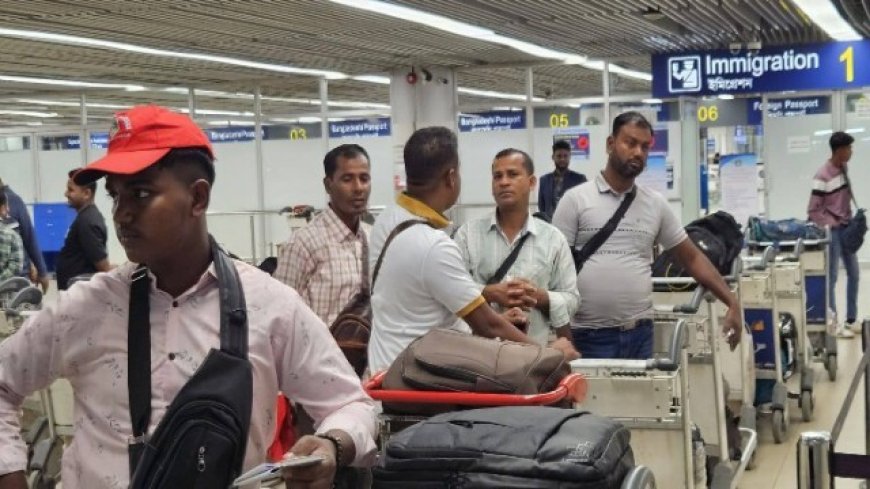
At least 54 flights scheduled to depart Dhaka's Hazrat Shahjalal International Airport for destinations across the Middle East have been cancelled, airport authorities confirmed Sunday, as the rapidly escalating military conflict between the United States, Israel, and Iran continues to force sweeping disruptions across regional aviation networks.
The cancellations, which affected routes to the UAE, Saudi Arabia, Kuwait, Qatar, Bahrain, and Oman, left hundreds of passengers stranded inside the airport's departure terminals — many of whom had arrived hours earlier without any prior notification from their carriers. A small number of flights are expected to depart in the afternoon, though schedules remain subject to change with little warning.
The scenes at Shahjalal Airport on Sunday morning reflected a wider reality playing out across South Asian aviation hubs, as airlines operating in Middle Eastern airspace recalibrate their operations in real time against a conflict whose geographic boundaries are still shifting.
Why Middle East airspace is under pressure
The flight cancellations are a direct downstream consequence of the military situation now unfolding across the region. Following US and Israeli strikes on Iranian territory — which targeted sites including the Natanz nuclear facility and command infrastructure — Iran's Civil Aviation Organisation issued advisories affecting airspace over Iranian territory. Subsequently, several Gulf states raised their own airspace alert levels as a precautionary measure.
Airlines operating long-haul routes through the Gulf corridor routinely pass through or near Iranian-controlled airspace. With that corridor now carrying elevated risk — both from active military operations and from unpredictable Iranian air defense responses — carriers have begun rerouting, delaying, or cancelling services rather than assume liability for flights through contested zones.
The situation is not unique to Bangladesh. Flights from India, Pakistan, Sri Lanka, and the Philippines — all countries with large labor migrant populations in the Gulf — are reporting similar disruptions. But the impact in Bangladesh carries particular economic weight. An estimated 2.5 million Bangladeshi workers are employed across the Gulf states, many of them on time-sensitive work visas and employment contracts with limited flexibility for delayed return.
What's Your Reaction?
 Like
0
Like
0
 Dislike
0
Dislike
0
 Love
0
Love
0
 Funny
0
Funny
0
 Wow
0
Wow
0
 Sad
0
Sad
0
 Angry
0
Angry
0












Comments (0)