


'Crazy idea' succeeds: Scientists monitor space junk with radio telescopes


Radio telescopes are designed to listen for signals from the stars and from distant galaxies, but scientists are also pointing out that these instruments can also track objects somewhat closer to home: junk in Earth's orbit.
Engineers have used the famed radio telescope at Jodrell Bank in the U.K. as part of an international plan to watch high-altitude space debris. Normally, old satellites and bits of spacecraft stuck up in geostationary orbit are too high up for our normal ways of watching space debris. However, said international project, called Long Baseline Multistatic Radar (LBMR), successfully used a radio telescope to get around this problem.
"That's the first time that's ever been done," Simon Garrington, associate director of Jodrell Bank, said in a video about the project.
A pressing problem
It's hardly a secret that junk is rapidly piling up in Earth's orbit — dead satellites, rocket remnants, rubble from satellite collisions or anti-satellite missile tests, and more. And as we keep filling Earth's orbit with thousands more satellites each year, we're also increasing the risk that one is struck by a debris fragment. We need to track this debris.
Most satellites exist in low Earth orbit (LEO) below altitudes of 1,250 miles (2000 kilometers), and indeed space debris is more concentrated at LEO. Still, there’s good reason to be just as concerned about debris in the much higher geostationary orbit (GEO), which falls 22,500 miles (36,000 kilometers) in altitude. Crucial communications and weather satellites lie in GEO, for instance, and space debris doesn't need to come in great quantities to pose a threat — just one unfortunate strike can cripple a satellite.
This leaves debris-hawks with a conundrum. They typically track space junk in LEO with radar, but most ground-based radar systems aren't sensitive enough to watch GEO's heights. Instead, they rely on optical telescopes to see objects in GEO. These telescopes are good for tracking larger objects (larger than about 4 inches, or 10 centimeters, across), but they can't resolve smaller objects as well as radar can. Yet these smaller objects can be just as deadly and destructive as their larger counterparts. If we want to see them with radar, we'll need especially sensitive receivers.
Fortunately, that equipment already exists, too — that's where radio telescopes can help.
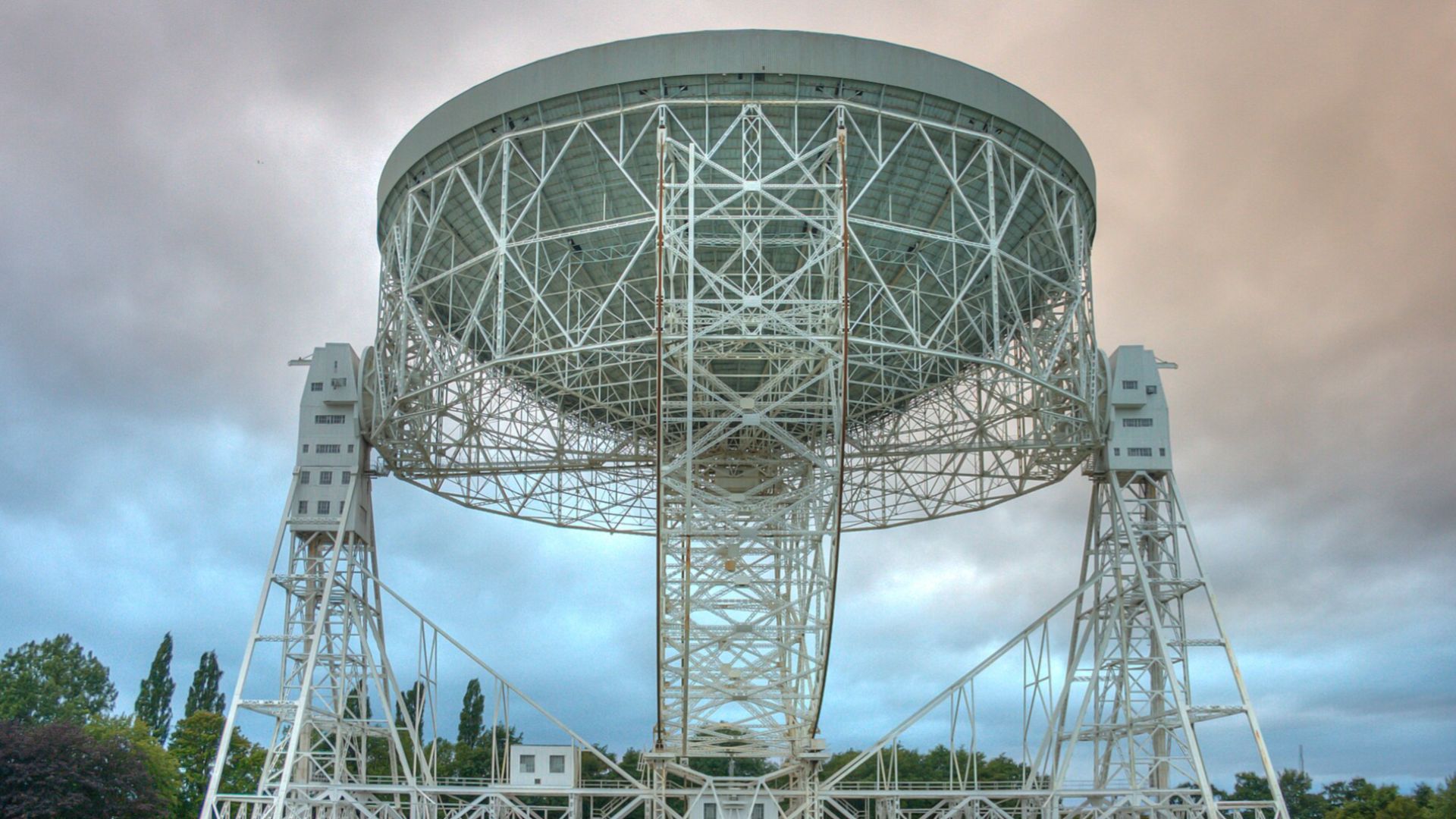
Engineers have tried debris-watching with radio telescopes as early as the 1990s, but LBMR, backed by NATO and the U.K. Space Agency, wanted to go further and watch debris in real time.
LBMR's engineers drew up a scheme to make this work. They would broadcast radio waves with a radar installation at the Massachusetts Institute of Technology's Lincoln Laboratory in the U.S. These radio waves would glance off debris and fall back into the dishes of U.K. radio telescopes such as the Lovell Telescope at Jodrell Bank. Back on the ground, the radio telescope's signal would be processed and analyzed in real time.
Aligning a radar transmitter with a radio telescope on the far side of an ocean, then processing its signals, is far easier said than done.
"This idea started about seven years ago. It sounded at that time like a crazy idea, because we had no synchronization. We had assets on one end of the ocean and other assets on the other end of the ocean," said Marco Martorella, an electronic engineer at the University of Birmingham and another member of LBMR, in a video. "But we were crazy enough to continue."
This required years of work, but the researchers have now successfully demonstrated that they can receive a signal with a single antenna. This has allowed them to track the distance to a piece of debris, and how quickly that distance is changing, in real time.
Next, the LBMR researchers hope to demonstrate that they can receive radar reflections of the same object with multiple radio telescopes at once. This, the researchers say, would allow debris-hawks to use the radio telescope technique to truly track debris in three dimensions.
What's Your Reaction?
 Like
0
Like
0
 Dislike
0
Dislike
0
 Love
0
Love
0
 Funny
0
Funny
0
 Wow
0
Wow
0
 Sad
0
Sad
0
 Angry
0
Angry
0











Comments (0)