


Stephen Hawking's famous 'leaky' black hole theory gets much-needed update

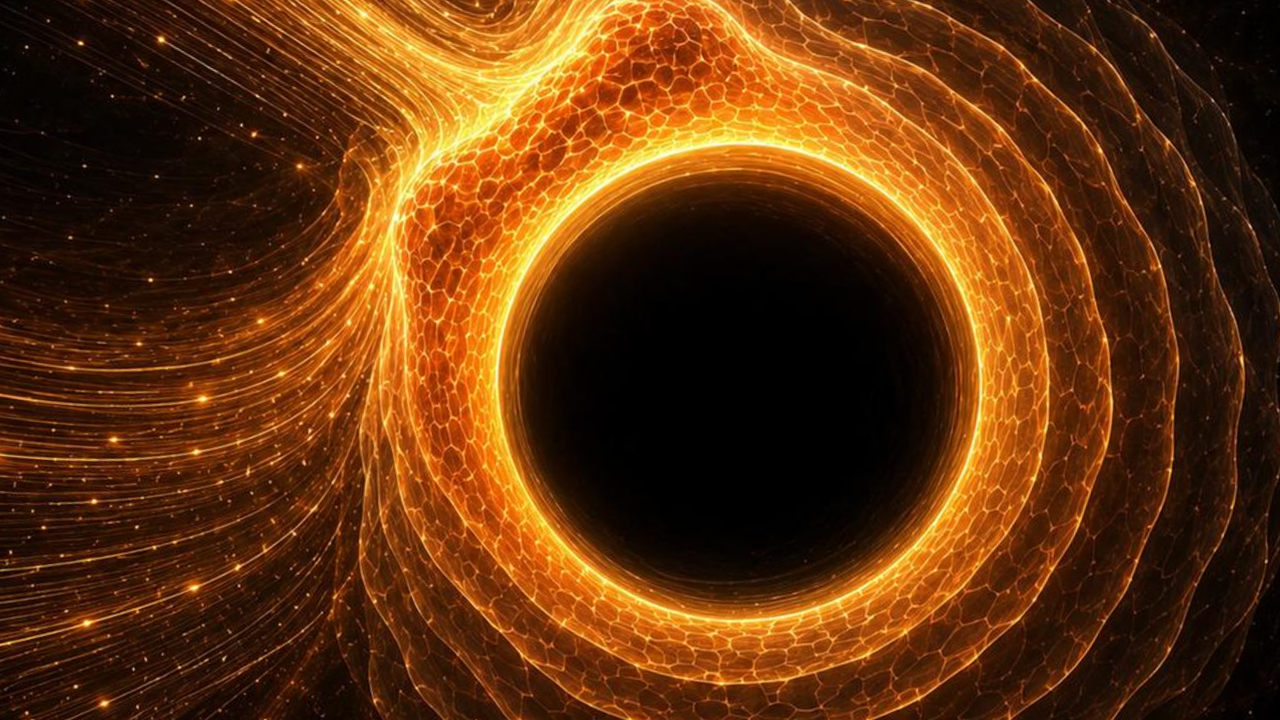
There may be an easier way to describe how black holes "leak" energy than the theory Stephen Hawking proposed — and the newly suggested process is similar to how we describe a boiling pot of water. This simple (well, relatively simple) description could be used to model black holes in many situations such as during their formation, mergers with other black holes, eventual evaporation and even explosive death.
In the 1970s, legendary theoretical physicist Stephen Hawking wrote a letter to the journal Nature entitled "Black hole explosions?" explaining how these objects may leak thermal radiation, evaporate and eventually implode at the end of their lives. This radiation eventually became known as Hawking radiation.
But in new research, scientists have suggested an alternative to Hawking radiation. It involves describing the increase in disorder, or entropy, of black holes. Boiling water, as an example, is also often described based on its increase in entropy. For black holes, this measure of entropy is connected to characteristics like spin and energy, which means it could be used to understand how these cosmic titans respond to different events.
"Hawking's laws of black hole mechanics provided a satisfying connection between extreme and ordinary physics and have been the paradigm for 50 years, but they have a serious limitation," team leader Abhay Ashtekar of the Eberly College of Science at Penn State University said in a statement. "They were formulated for black holes at equilibrium — or unchanging over time — but black holes are constantly changing; they form, merge, and eventually evaporate. We wanted to find a way to overcome this limitation and extend the laws to black holes that are out of equilibrium."
Black holes, Einstein and Hawking
To investigate the origins of black holes, one has to go back to history's most famous physicist (sorry Hawking, you're number two), Albert Einstein.
In 1915, Einstein revealed his theory of gravity, general relativity. One consequence of the equations underpinning that theory was the possibility of a singularity, a point at which the equations of general relativity go to infinity. This represents the heart of a black hole.
Another consequence of the general relativity equations is a region of space around this singularity at which gravity is so extreme that the escape velocity of the area increases to a value greater than the speed of light. That region is the light-trapping outer boundary of the black hole known as the event horizon, which prevents us from ever seeing the singularity at the heart of the black hole or receiving information from it. In fact, until Hawking's work in 1974, this is why it was proposed that nothing at all can escape a black hole.
"The laws of black hole mechanics came directly from Einstein's equations," team member Daniel E. Paraizo, a graduate student in physics at Penn State, said. "Because you cannot see into a black hole, it seemed that there could be an infinite number of ways to make a black hole, making their entropy infinite as well. They were also thought to only absorb energy and never radiate, so their temperature was zero."
However, the advent of Hawking radiation somewhat changed this paradigm. By suggesting that black holes actually radiate thermal energy, Hawking redefined them in such a way that suddenly the laws of thermodynamics could be applied to black holes.
"This changed the thinking about the thermodynamic properties of black holes from a sort of mathematical concept described by equations, to being more of a physical reality," Paraizo said. "This opened the door to finding analogies in black holes of entropy and temperature used in thermodynamics."
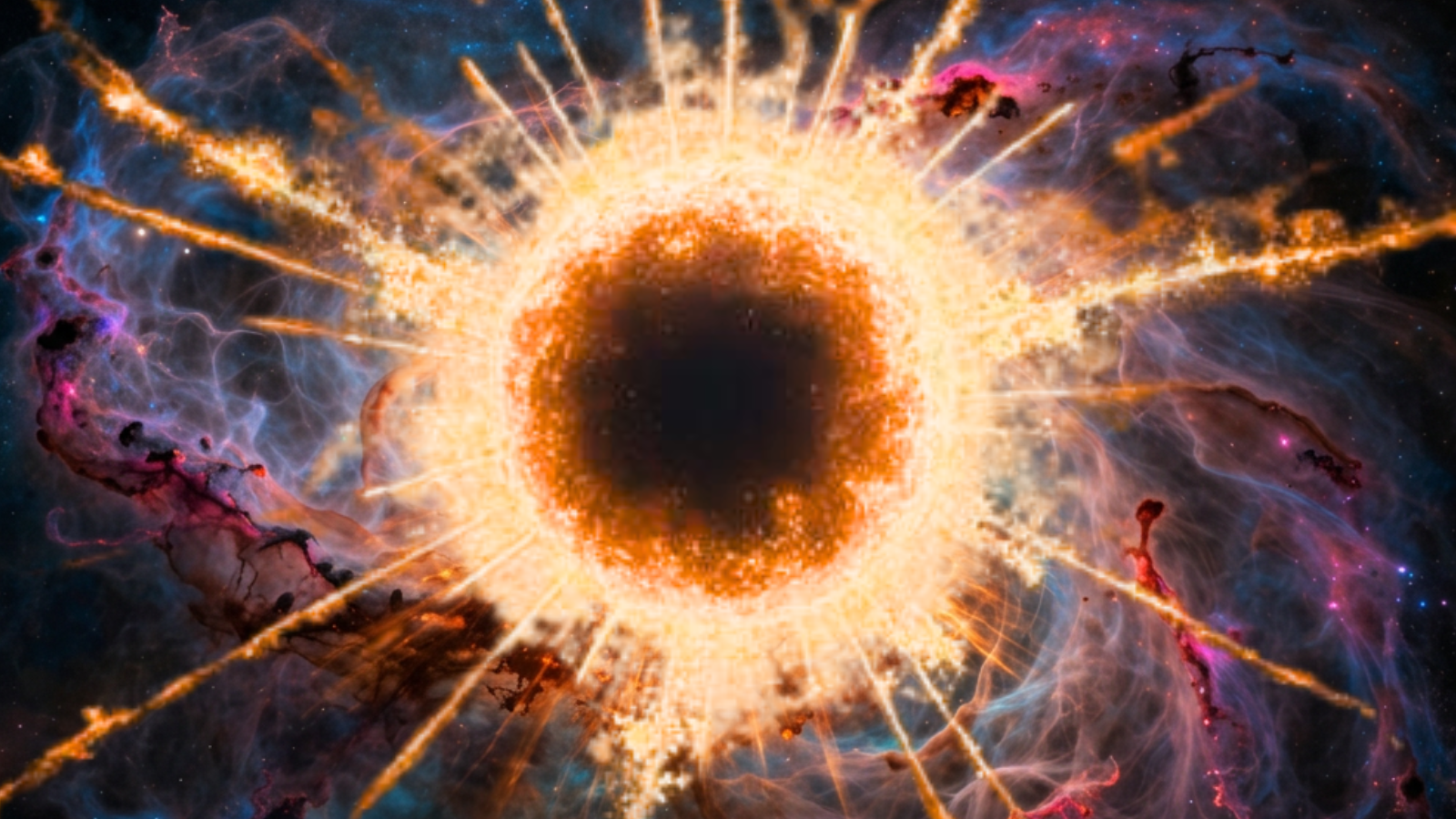
In Hawking's recipe for black holes, the area of the event horizon is proportional to its temperature and entropy, and is inversely proportional to its mass and its spin.
"There is a problem, though," team member Jonathan Shu, also from Penn State, said in the statement. "These analogies only really work for a black hole that is at equilibrium. In dynamic situations, event horizons can form and grow in what we call flat regions of space-time, where nothing is happening."
Shu added that a consequence of this is the properties of black holes cannot be determined just by the local physics of the black hole. Instead, determining the properties of black holes relies on the prediction of events that may or may not happen in the future.
"Therefore, the area of event horizons cannot be a measure of the physical entropy of dynamical black holes," Shu argues. "If we want to understand black holes that are growing, evaporating and merging, we need a viable alternative."
For the team, this meant replacing the event horizon of a black hole with something they call a "dynamical horizon," already used when scientists simulate black holes. Now, the first law of thermodynamics — which states the energy of a closed system cannot be created or destroyed but rather can only change forms — can be applied to black holes even when they are involved in dynamic acts. It also means black holes are subject to the second law of thermodynamics, which says the total entropy of an isolated system will always increase over time, during their birth, merger and death.
"This allows us to extend the first and second laws of thermodynamics to black holes that are not at equilibrium, thereby overcoming the limitations of the paradigm that has been used for over half a century," Ashtekar said. "We can apply these generalized laws to better understand evaporating black holes in quantum theory and black hole mergers."
The team's research was published in June in the journal Physical Review Letters.
What's Your Reaction?
 Like
0
Like
0
 Dislike
0
Dislike
0
 Love
0
Love
0
 Funny
0
Funny
0
 Wow
0
Wow
0
 Sad
0
Sad
0
 Angry
0
Angry
0












Comments (0)