


🏫 Y! Sports Biz: Time to take the cap off?


👋 Welcome to Wednesday! The summer sports doldrums don’t apply to sports business. Come on in — there’s lots to discuss. Tell your friends and colleagues to subscribe!
In today’s edition: Big news for two of sports’ biggest owners, college sports are set to spend, soccer spending is out of control, many million-dollar jerseys, and more.
Time to show you the money...
⚡ ICYMI
LIGHTNING ROUND
(Lars Baron/Getty Images)
⚽ World Cup Final shatters viewership records: Fox and Telemundo revealed a combined total of 66.4 million average viewers for Sunday’s World Cup Final, easily making it the most-watched soccer telecast in U.S. history. It was more-viewed than any non-Super Bowl NFL game since 1981, and it was the most-viewed non-NFL, non-news event since the 1998 Seinfeld series finale. The Summer of George lives on…
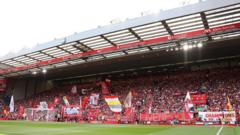
🤝 FSG in talks over minority Liverpool sale: Fenway Sports Group is reportedly in discussions to sell a minority stake to a consortium led by Amit Bhatia and backed by the Mittal family, according to the Financial Times. Sky reports that Jeff Bezos has been approached to join the consortium. The sale would reportedly value the club at over $6 billion. FSG bought the club in 2010 for £300 million (~$475 million at the time).
🧐 Feds probing Walter empire: Federal prosecutors are reportedly investigating two insurance companies owned by Mark Walter, as well as Guggenheim Partners, over potential financial improprieties. Walter’s sports portfolio includes the Dodgers, Lakers, Sparks, PWHL, Cadillac F1, and Chelsea FC.
📺 Major layoffs at ESPN: ESPN has conducted a significant round of layoffs this week, most of which resulting from redundancies caused by the acquisition of NFL Network, though other employees were also impacted. Among those let go were NFL analyst Ryan Clark, MLB play-by-play announcer and host Karl Ravech, and NFL insider Tom Pelissero.
🏀 Walton heiress adds to list of Vegas NBA suitors: Nancy Walton Laurie and Bill Laurie are weighing a bid for the NBA’s Las Vegas expansion franchise, reports Sportico. Their interest adds to a lengthy and growing list of reported suitors. Has nobody told these folks there’s also a Seattle team available?
See what else is trending on the Yahoo Sports Business Hub.
🏫 LEGISLATIVE GRIDLOCK
COLLEGE SPORTS UNSCREW THE CAP

(Harry How/Getty Images)
Just weeks from the kickoff of the college football season, legislators are struggling to chart a path forward for collegiate athletics. Negotiations continue in an ongoing effort to shape a version of the Protect College Sports Act that can pass through Congress, a feat that seemingly cannot be achieved without the support of the Big Ten and SEC.
The state of play: In its original form, the legislation — and surrounding discussion — took aim at the titans’ advantage in resources, targeting their perceived “super league” ambitions and creating impetus for them to pool their media rights for the greater good. However, the intensity of those attacks has waned as the urgency of passing legislation rises.
- Reeling the Big Ten and SEC into the boat has required flexibility on several proposed revisions, including reinforcing the voluntary nature of rights pooling and relaxing restrictions on conference movement.
- The most recent and notable topic of negotiation, however, concerns making the athlete compensation framework more flexible. Potentially a lot more flexible.
Ross Dellenger, Yahoo Sports
That [framework] includes a proposed idea to establish a separate pool of money for schools to use to retain current athletes on their rosters. This "retention pool," as some refer to it, would be in addition to the $21.3 million revenue-share cap for the 2026-27 academic year. Other ideas under discussion include a general increase in the cap itself and the addition of a sort-of luxury tax on over-spenders.
But as negotiations persist, the idea of a separate retention pool is gaining momentum from some.
According to the latest conversations, schools would have available to them $20-30 million for retaining players — a figure that when combined with the traditional cap provides schools with a total cap of $40-50 million for all of their athletes. This aligns more with the current spending in the market.
Same, but different. In this scenario, revenue-share caps and retention pools feel an awful lot like left and right pockets in the same pair of pants, but whatever they’re called and however they’re split, they would potentially more than double current spending limits concurrently with legislation that aims to reduce circumvention of those limits.
- But not so fast, my friend: All of these revisions remain the subject of negotiations, far from becoming crystallized in final pieces of legislation.
- More importantly, the increased spending flexibility may run afoul of the NCAA House Settlement — or at least require progression through an associated approval process, which could be both time-consuming and fraught with stumbling blocks.
Can’t spell secede without SEC: Though many have taken it as an empty threat, SEC commissioner Greg Sankey has continued to label the possibility of a conference breakaway* as “real,” noting frustrations with the persistent state of flux and the unresolved legal quagmire.
Crunch time: The Senate breaks for a month-long recess on August 7, and pre-midterm progression could be slow, heightening the urgency to bring a finished bill to the floor. But the clock is ticking, and the Big Ten and SEC could still be linked in their unlikely legislative unity when their teams clash in early September. The battle at the bargaining table feels far more consequential than the one between Ohio State and Texas.
*Those who read “This Day in History” in Friday’s Y! Sports Biz know there’s precedent for this type of maneuver…
💲 STEEP STITCHING
PRICE TAGS

(Christian Petersen/Getty Images)
On Monday night, Sotheby’s sold four pieces of sports memorabilia for over $1 million each, bringing total sales for its Summer Sports Week to $26 million, as collectors continue to covet blue-chip assets representing pivotal moments from superstar careers.
Luka Dončić NBA Debut Jersey: $1,024,000
Before Luka Dončić became a global superstar — before we even knew the Trae Young trade was lopsided — there was this: the jersey worn in his first-ever NBA game, where he notched 10 points, 8 rebounds, and 4 assists. The rest, of course, remains history still in the making.
Much appreciated: The jersey was originally purchased in 2018, shortly after Dončić wore it, for $38,020. Since then, it has increased in value by 54% annually, which, even by the high standards of the red-hot memorabilia market, is an incredible number.

(Rich Schultz/Getty Images)
Aaron Judge MLB Debut Jersey: $1,792,000
In the very first at-bat of his MLB career, Aaron Judge launched a 446-foot home run, the first notch in a tally that now numbers 385. Few assets can match the cultural appeal of the first official pinstripes donned by a Yankee icon, a reality that drove his debut jersey’s price toward $2 million. Now, just imagine if that debut jersey had a debut patch attached…
Just a bit outside: The price was actually a disappointment relative to an ambitious $3 to $5 million estimate. Get this: Judge’s most expensive card sold in March for $5.2 million. He wasn’t the only Bronx Bomber to come up short: a heavily worn Derek Jeter jersey, famous for “The Dive,” sold for $576,000, below a $500,000 to $700,000 estimate before fees.

(Jeff Gross/Getty Images)
Kobe Bryant ‘09 NBA Finals Game 1 Jersey: $1,664,000
Kobe Bryant began his 2009 climb to the top of the NBA mountain with a dominant 40-point performance in a Game 1 Lakers victory over the Magic. The Lakers would clinch the title, Bryant’s first without Shaquille O’Neal, in Game 5, with the Mamba earning Finals MVP honors. That Game 1 jersey sold for $1,664,000 against a $1.5 to $2 million estimate.
Mamba rising: As with Dončić’s jersey, Bryant’s sold initially in the near-aftermath of its use for only $35,270. Over the course of 17 years, it has appreciated at an annual rate of 25%. Not Dončić territory, but remarkable given at least some of Bryant’s legend (he had four titles) had already been written at the time of the initial sale.
Plus: A section of Bulls hardwood that sat center-court during the 1996, 1997, and 1998 Finals sold for $1,792,000, thoroughly outperforming an $800,000 to $1,200,000 estimate. Finally, my basement is complete.
⚽️ SOCCER STICKER SHOCK
TRANSFERFLATION RUNS RAMPANT

(Michael Regan/Getty Images)
With Chelsea’s reported $157 million signing of Morgan Rogers from Aston Villa now complete, Rogers has become the most expensive British player on record and the fourth player to sell for more than $100 million this summer. All four will remain in the Premier League, as the English giants flex their financial might in an accelerating arms race for talent.
Rampant “transferflation”: While Rogers and Elliott Anderson, who sold for $155 million this summer, are great players, they’re not the Galacticos (think: Mbappé, Ronaldo, Neymar) who used to command the market’s top dollars. The spiraling fees paid for players of this caliber raise questions of sustainability.
Sticker shock: From 2016 to 2026, English transfer spending has risen 179%, according to FIFA data. Consider that the U.K. consumer price index increased only 37% over the same period, though, and it’s clear that “transferflation” is a different beast.

Lonely at the top: Though global transfer spending has kept pace with England, the super-sized deals now belong predominantly to the Premier League.
- In the last 10 summer transfer windows (including the ongoing one), there have been 24 deals worth over $100 million; in 14 of those, a Premier League club was the acquirer.
- Shrink the scope to the last 5 summer windows, and the Premier League accounts for ten of 13 nine-figure deals.
- The value of homegrown players — with squad rules requiring eight — gives the recent jackpot sales a distinctively English hue, as Premier League clubs pay an “English tax” for players like Rogers and Anderson.
Put it in perspective: English clubs are empowered to spend by their sizable revenues. Relative to those growing revenues, today’s eye-popping spend looks slightly more modest. In fact, if we indulged the suggestion that “the game is gone” every time a player sold for big money, we would’ve left soccer somewhere in the mid-90s.
- Football finance specialist Kieran Maguire and his colleague Jason Laws indexed each summer’s top transfer fees to Premier League revenues. In their findings, the top transfers — relative to revenue — came in 1996 (Shearer), 2002 (Ferdinand), and 2001 (Veron).
- Rogers and Anderson would rank somewhere in the mid-20s. It doesn’t dismiss the absurdity of their fees, but it does suggest that clubs were stretching themselves more at the turn of the millennium than today.
- Still, it’s worth noting that the 12% annual rise in English transfer spending doubles the 6% revenue growth rate in the Premier League over the last decade.
Scary thought: The reported transfer fees are merely the tip of the iceberg for what clubs actually spend on new players. Those fees don’t include the ~10% agent’s cut, the Premier League’s 4% levy on transfers, or the player’s actual wages, all of which are layered on top!
Pump the brakes: There are financial regulations in place, but as Chelsea — a team that finished 10th last year — just splashed $157 million on a player, they are perhaps not prohibitively restrictive for the league’s commercial superpowers.
- The old rules, based on profits, have proven more restrictive to clubs fighting to ascend alongside the league’s elite. Take, for instance, Aston Villa, who have sold Rogers and other key players in recent seasons to balance the books.
- This summer, the league launches a new set of financial rules which require clubs to keep their squad costs below 85% of revenues. However, with violations up to a threshold of 115% punished by fines, rather than points deductions, expect clubs to behave accordingly.
Bottom line: The Premier League arms race shows no signs of slowing… as long as revenues keep rising. However, with clubs already spending beyond that growth, it cannot persist forever.
⚽️ PERFORMANCE PERSONNEL
DREAM JOB: IT'S NOT ROCKET SCIENCE

(Jamie Squire/Getty Images)
It’s time to stop worrying about what would happen if our best athletes played soccer. What if our best scientists focused on soccer? That’s the question we need to be asking.
Mad scientist wanted: Nike and U.S. Soccer are hiring a Performance Innovation Lead for the newly created Performance Innovation Lab at U.S. Soccer’s Arthur M. Blank National Training Center in Georgia.
This role sits at the intersection of elite applied sport science and rigorous research, and given its location, will be embedded within U.S. Soccer’s daily operations while maintaining a strategic research agenda that generates new knowledge for the federation, its athletes, and the broader U.S. soccer ecosystem. As a Nike position, the role will also support select non-soccer Nike initiatives and athletes who access the facility and Performance Innovation Lab, creating cross-sport research opportunities.
Dual-pronged remit: The role, technically contracted with Nike but part of an initiative backed by both the Swoosh and U.S. Soccer, will drive performance innovation on two fronts.
- Advance the science and practice of elite soccer performance across 27 U.S. Soccer National teams.
- Support soccer and non-soccer Nike initiatives and athletes.
Sport Offense: The position breathes life into Nike’s “Sport Offense,” an initiative at the forefront of the company’s innovation-led turnaround efforts. Nike management has frequently touted the importance of innovating in sport to propel the brand forward across the board.
Space race, but make it soccer: Perhaps this patriotic pursuit can land Americans on the World Cup podium and Nike back on a winning path.
🎙️ MERGER MUSINGS
NOTABLE QUOTABLES: AEW'S TONY KHAN ON PARAMOUNT-WBD

(Yahoo Finance Power Players)
On Monday, All Elite Wrestling (AEW) CEO Tony Khan joined Yahoo Finance’s Brian Sozzi on Power Players to discuss the explosive global growth of his professional wrestling empire and his data-driven approach to the NFL and Premier League. But, in light of recent news, it’s his thoughts on the massive Paramount and Warner Bros. Discovery merger that caught our eye.
Merger means more eyeballs: Khan shared his POV on the pending mega-merger, explaining what it might mean for AEW, which signed a multi-year media rights deal with WBD in 2024 worth a reported $185 million annually. Core to his excitement about the deal is the prospect of viewership gains generated by a company that would be stronger than the sum of its parts.
"I think HBO Max and Paramount are going to be much stronger and far more competitive together in the streaming space than they are separately," Khan explained. "It's not going to be anything resembling a monopoly in streaming because it's a hard fight out there. But together, I think we'll have more viewers with Paramount, and we'll be able to sell pay-per-view into more homes, stream the show into more homes, and we'll have a bigger future.”
Time-out: Later on Monday, a federal judge ordered Paramount and WBD to halt their merger for at least two weeks as states challenge the deal in courts on anticompetitive grounds. Despite Khan’s dismissal of any monopolistic standing, 12 states — led by California — have expressed concerns about “extinguished competition” in Hollywood and reduced consumer choice.
Big picture: Khan leads one of countless businesses in sports, entertainment, and beyond who will see their futures shaped by the outcome of these proceedings. From the parties to the merger themselves to their partners, competitors, customers, advertisers, and employees, the stakes could scarcely be higher.
🟣🟡 LET'S PLAY
PATCH THINGS UP: PURPLE AND GOLD

(Los Angeles Lakers)
The Lakers recently announced a new jersey patch sponsorship with Albert, an AI-powered financial assistant. ESPN’s Dave McMenamin reported that the deal could be worth more than $30 million annually.
Question: In the picture below, we have removed the Lakers’ outgoing sponsor from LeBron James’ jersey. Who was that sponsor?

(Sean Haffey/Getty Images)
Hint: Wontons and dumplings.
Answer at the bottom…
🔮 SOCCER SOOTHSAYER
EA'S CRYSTAL SOCCER BALL

(EA Sports FC on X)
While EA has endured plenty of criticism for its microtransactions in College Football 27, its predictive capabilities in soccer are beyond reproach. The company’s pre-tournament simulations of the World Cup, run through its EA FC (formerly FIFA) games, have now correctly predicted the winner five consecutive times.
Not just chalk: The game’s prowess is not simply the result of picking the world’s top-ranked team. In fact, in those five correct predictions, their pick’s pre-tournament ranking has never been No. 1: 2010, Spain (2nd); 2014, Germany (2nd); 2018, France (7th); 2022, Argentina (4th); 2026, Spain (3rd).
Patch Things Up Answer: Bibigo! The Korean foodmaker served as the Lakers’ jersey sponsor for five years in a deal reportedly worth $100 million. Was that money well spent?

(Sean Haffey/Getty Images)
Thanks for reading! Wanna talk shop? Follow me on X and Linkedin, or drop me a line: dylan.dittrich@yahooinc.com.
What's Your Reaction?
 Like
0
Like
0
 Dislike
0
Dislike
0
 Love
0
Love
0
 Funny
0
Funny
0
 Wow
0
Wow
0
 Sad
0
Sad
0
 Angry
0
Angry
0














Comments (0)