


Astronomers discover 1st atmosphere around a rocky Earth-like planet in the habitable zone

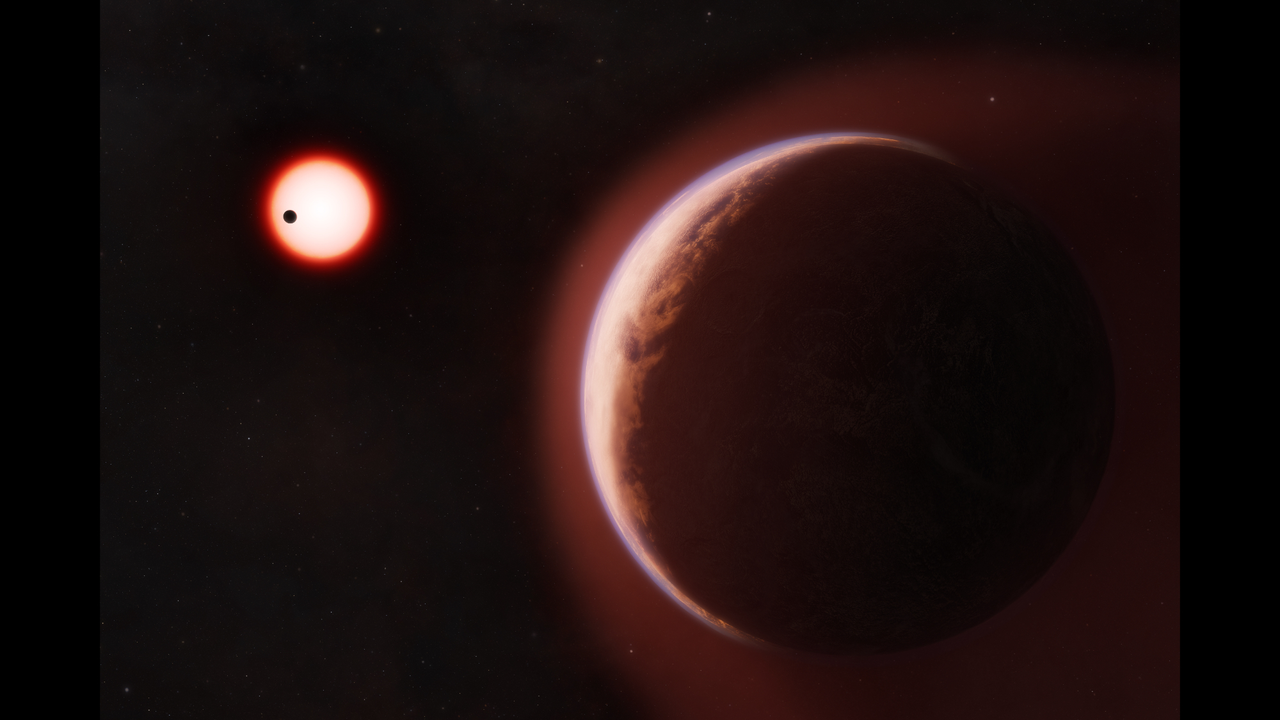
This might be the closest we've gotten to finding a planet that could support life: Astronomers have detected an atmosphere around an Earth-like, rocky planet orbiting in the habitable zone around its star, a monumental first.
The rocky planet, called LHS 1140 b, is 48-light-years away from Earth and according to this new research, it has an atmosphere that contains helium. It is also the first rocky planet to have an atmosphere be detected directly. This is the first rocky planet to be found with an atmosphere that is also in the habitable zone, meaning it's at the right distance away from its star for liquid water to potentially exist on the planet. As we continue to search the cosmos for planets that can be considered "habitable," this planet checks more boxes than almost anything we've ever seen.
"We have actually detected directly the helium present in the atmosphere itself, and that's the first direct detection for any rocky exoplanet, which is really exciting … and then there's this added bonus that it's in the habitable zone, which is super exciting for astrobiology and habitability and searching for life," lead author Collin Cherubim, who recently earned his Ph.D. from Harvard University, told Space.com. "It feels kind of surreal."
What's this planet like?
Let's explore this planet and the system where it "lives."
This exoplanet, or planet outside of our solar system, was first discovered in 2017 by a team led by astronomer Jason Dittmann who is now a co-author on this new discovery.
"This planet was found like 10 years ago, and we're just now saying, okay, that's an atmosphere," Dittman told Space.com. "We're slowly narrowing the gap and checking these boxes … we're finding a planet that's rocky, a planet that's of the right temperature and now … it's like okay, we finally found one that has an atmosphere."
And being a rocky planet, "there's definitely a surface … it's made of rocks," Dittman said. What does the planet's surface look like? We can't say yet, but the researchers who found this planet's atmosphere think there's a good chance it could have water.
While it orbits a red dwarf star, which is smaller and cooler than the sun, it orbits closer than we do to our star, maintaining a temperature that keeps the planet in the "Goldilocks zone" where liquid water could exist on its surface.
"It probably also has a lot of water," Cherubim said. "If it has some amount of atmosphere that can provide a bit of a greenhouse effect, which we know that it does now … it will very likely be what we consider to be habitable conditions on Earth, and conditions that would likely support liquid water."
So is it Earth-like? While it's certainly not an Earth copy, this planet can be considered Earth-like in two main ways, Cherubim shared. One: its overall composition. The planet is rocky, likely with an iron core and (now we know) it has an atmosphere. And two: the planet's temperature is just right for liquid water, which is necessary for life at least as far as we understand it on our planet.
Finding an atmosphere
The discovery of the first exoplanet was confirmed just over 30 years ago. Since then, scientists have found over 6,000 exoplanets and counting. And while a few rocky planets have been found in their star's habitable zone, it wasn't until now that an atmosphere has been confirmed around a rocky planet in the habitable zone.
One reason why scientists have had a hard time finding such planets with atmospheres is their stars. LHS 1140 b orbits the most common type of star, a red dwarf, which is about one-third the size of our sun. This type of star remains active for a lot longer than stars like our sun. This activity means it releases bursts of extreme radiation like solar flares and coronal mass ejections. And typically, the extreme radiation around these stars totally strips the atmospheres from the planets orbiting them, so astronomers have wondered if planets orbiting these stars can have an atmosphere at all.
"This discovery is a big deal because it's showing that at least this rocky planet has retained an atmosphere over billions of years," Cherubim said. It's "a bona fide, robust way of saying yes, atmospheres can survive on rocky exoplanets."
It's possible that other gases beyond helium are in the planet's atmosphere, and it's possible that some of its atmosphere was previously stripped away by its star's radiation. But the red giant that this planet orbits is roughly 6 billion years old, a few billion years older than the age at which their extreme radiation activity begins calming down. So while some helium is still slowly escaping the planet's atmosphere over time, the team expects the planet to retain an atmosphere, Dittman shared. After all, even Earth's helium is slowly escaping our own atmosphere.
The proof is in the atmosphere
To prove that this planet has an atmosphere, the team started with a prediction that Cherubim made during graduate school. It all started with a theoretical model and a sneaking suspicion that there must be rocky exoplanets with atmospheres other than Earth.
"This came out of a very specific prediction from a planetary evolution model that I actually developed myself, from scratch, from first principles, for my Ph.D. as a theorist, and I made a very specific prediction about this planet," Cherubim said. "And then I went out and did a pretty unexpected, weird thing using this technique that's typically reserved for observing giant planets, and I used it for a rocky planet, which nobody has done before.
"And lo and behold, I made this measurement that was actually consistent with my prediction. And it was really nice to kind of close the whole loop of the scientific method."
The team took the theoretical model that Cherubim developed in graduate school and put it to the test using the Warm Infrared Echelle (WINERED) Spectrograph on the Magellan Observatory in Chile. And with their observations, they were able to see LHS 1140 b and another planet both transit, or pass in front of, their star in the same night. With this spectrographic data, they could identify the signatures of molecules in the atmospheres of these planets as they passed in front of the star. And while one planet yielded no results, this planet showed a direct, undeniable helium signature.
Are there aliens?
When looking at a planet that is rocky, has an atmosphere, and is in the habitable zone (meaning it could have liquid water), the question of life comes up quite quickly.
But the researchers don't have enough data to make that conjecture. "I'm not claiming this planet has life," Cherubim made clear. With further investigation, scientists could better understand what else might be in this planet's atmosphere, and they could confirm if it has water. Further observations might not be able to confirm habitability or identify any life on the planet, but they could at least help us to better understand planets like this.
With this being the first planet of its kind discovered, further exploration will help us to put the pieces together. But it is certainly a major step forward in the eternal human quest to answer the question: are we alone?
This work was described in a study published in the journal Science.
What's Your Reaction?
 Like
0
Like
0
 Dislike
0
Dislike
0
 Love
0
Love
0
 Funny
0
Funny
0
 Wow
0
Wow
0
 Sad
0
Sad
0
 Angry
0
Angry
0











Comments (0)