


Astronomers discover landslides on Pluto large enough to bury entire cities on Earth

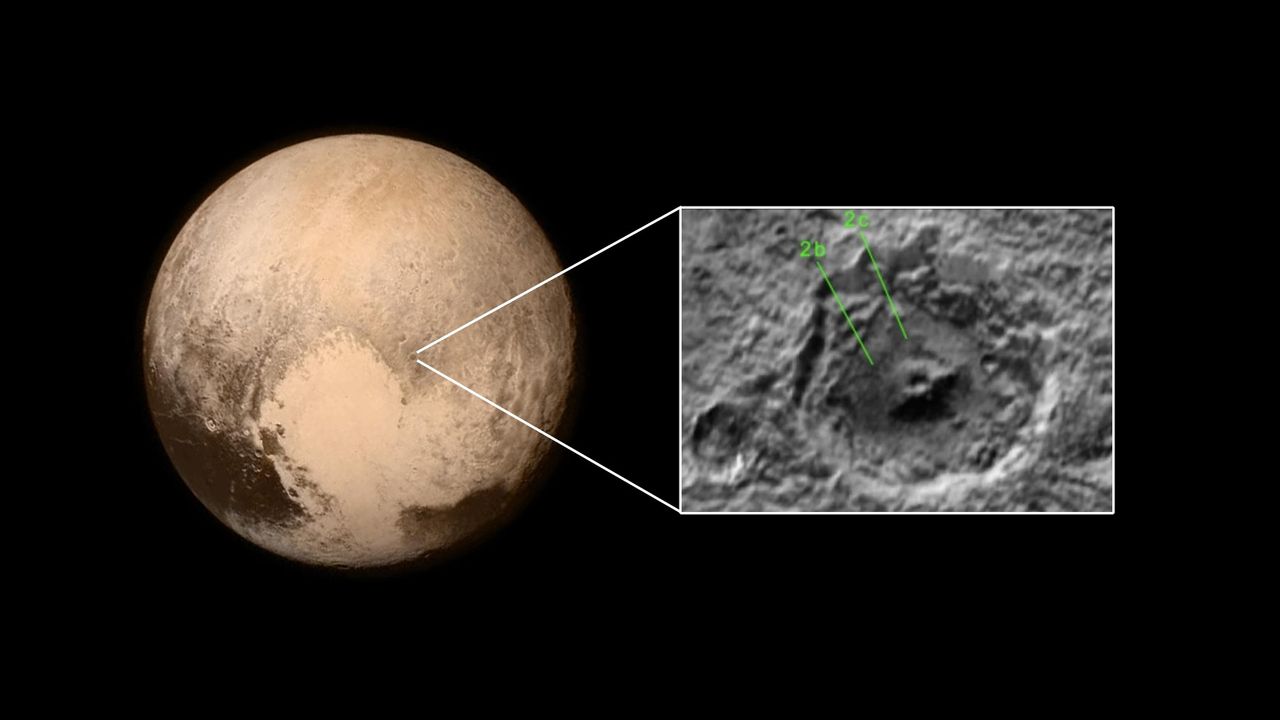
The aftermath of landslides have been found in images of Pluto's surface taken when the New Horizons mission flew past the dwarf planet in 2015. The landslides are evidence that the icy world is still active, albeit on geological timescales.
A team led by geologist Marco Emanuele Discenza pored over images taken by New Horizons' LORRI (Long-Range Reconnaissance Imager) instrument, which was capable of detecting surface features as small as 984 feet (300 meters). They found convincing evidence for six landslides in total that have taken place down the inner walls of three craters on the western edge of Sputnik Planitia, the heart-shaped feature that characterizes Pluto's appearance.
Previously, geological features left behind by landslides have been found on a host of bodies in the solar system, including Mars, Ceres in the asteroid belt, some of the icy moons of the gas giants, and even Pluto's companion, Charon. However, these are the first to be found on Pluto.
A landslide that fell 1.4 miles (2.2 kilometers) was identified in Pluto's Coughlin crater, close to a secondary crater on Coughlin's rim that may have triggered the landslide in the first place. Two further landslide features were seen in Giclas crater, and another three were spotted in a third, unnamed, crater.
The landslides were identifiable by their large debris aprons that spilled out onto the crater floors, the distance the landslide material travelled ranging being between 6.3 and 9 miles (10.1 and 14.5 km). Some of these debris aprons appeared bumpy, as if they contain large boulders of solid ice, while the areas around the source of the landslides feature well-defined, concave-shaped cliffs where material has broken away and tumbled down the craters' steep walls.
The great lengths that the debris rolled means that Pluto's landslides are among the most mobile in the solar system, a product of low gravity and low-friction icy rubble. The largest of the debris aprons covers 50 square miles (130 square kilometers), which would be large enough to bury a small city or a large town.
Landslides are important processes in shaping planetary surfaces, enabling the transport of material across great distances. The trigger for Pluto's landslides, however, is not yet clear. While the landslide in Coughlin appears to have been caused by a smaller impact nearby, the other five have less certain origins. One possibility is thermal stresses in the surface ice caused by the slight temperature changes that cause Pluto's volatile materials – among them molecular nitrogen, carbon monoxide and methane – to periodically sublimate and then condense again. These temperature changes are the result of Pluto subtly heating up and cooling down as its elliptical orbit brings it slightly closer to the sun, crossing inside Neptune's orbit, and then moving farther away again.
There is also evidence for more landslides in other craters, but New Horizons' coverage of Pluto's surface was limited as it hurriedly flew past on July 4, 2015, and the imagery required to confirm these other landslides is lacking.
The findings were published in the journal Icarus.
What's Your Reaction?
 Like
0
Like
0
 Dislike
0
Dislike
0
 Love
0
Love
0
 Funny
0
Funny
0
 Wow
0
Wow
0
 Sad
0
Sad
0
 Angry
0
Angry
0













Comments (0)